11.16.2009

No means no

I have to admit that I’m not the biggest fan of Agra. Besides the disagreeable weather (it was hot and sticky), the touts are particularly aggressive there. In most places, you can generally ignore the men who offer rickshaw rides, invitations into their trinket shops, or suggest that they be your guide into the historical site you’re about to enter – or, at any rate, you can say, “No, thanks,” and keep walking. In Agra, these same guys are rather pushy and will follow you down the street, hawking their wares or services. No matter how often you say no, they’ll just keep at it, until you finally have to resort to being rude to get them to leave you alone – and then they’ll act insulted. The moment we walked into the street, we would be followed by guys trying to give us rides on their bike rickshaws or who wanted to sell us postcards and magnets with pictures of the Taj Mahal on them. We might as well have had big neon signs over our heads that said, “We have money” – because that’s how we were being treated, as walking receptacles of money that, if the touts could just squeeze the right way, would issue rupees.

We took an auto rickshaw forty kilometers outside of Agra to see the ancient city grounds of Fatehpur Sikri. As we neared the town, two guys who were standing in the street actually stopped our rickshaw and climbed in to offer us their guide services. Danny told him no and no again, but they persisted, insisting they were genuine licensed guides and also dropping the price lower and lower. When Danny and I started to get angry, they finally got out of the rickshaw but acted like we were doing them some kind of disservice. When we finally reached the site, we found out we actually had to walk the last kilometer to the ruins – or take a second rickshaw, which seemed like just a way for the locals to make extra money off the tourists. As we headed up the road, we found ourselves being followed by a boy offering his services as a guide. We said no, but he followed us anyway. In fact, he followed us for several minutes, trying to tell us about things that we walked by, and we simply ignored him. Finally, Danny had to say again that we didn’t want a guide. The boy then asked me directly (he’d mostly been talking to Danny this whole time – I often get ignored in conversations), and I said, “No, thank you.” He got really mad then and took off in a huff.


All of this persistent and aggressive touting really put me in a sour mood, which is too bad because the ruins of Fatehpur Sikri’s old city were really cool. My favorite thing about exploring cities, especially ones with hundreds of years of history, is the ruins of palaces, forts, and other buildings. I love trying to envision what these places once looked like when they were functioning and bustling. It’s especially interesting to find bits of ancient plumbing, fading paintings, or crumbling reliefs or statues.


The old city still provides a hanging out place for the poor who live in the surrounding area. They sit around the ruined buildings or graze their goats on the overgrown shrubbery. There were several little boys who wanted to say hello and start conversations, but I was beyond being polite at that point, so I just ignored them. I felt bad about doing so, since I knew it wasn’t that big of a deal to just wave or answer a few simple questions (“where you from?”). But it was becoming rather apparent that the locals would take any opportunity to make a sale or ask for money – and it all starts with the acknowledgment of the person who is hoping to collect. Exchange simple hellos, and it’s assumed that you’re ready and willing to have further conversation, which often ends with an invitation to buy some trinkets you don’t actually want. (I did, however, smile at a small boy who was standing at the very top of a tower over our heads and was rewarded with a shuffling dance.)


As is our habit when we visit these sprawling monuments, we spent at least two hours wandering the old city and never actually made it to the main grounds of Fatehpur Sikri. It would have been nice to explore it, as it’s supposed to be one of the must-sees of India, but I didn’t mind not having to pay the Rs. 250 fee to get in. Instead, we hung out with a quartet of grazing goats, walked on the domed roofs of old buildings, and watched school children explore a tall tower studded with phallic-looking tusks jutting out from all sides.


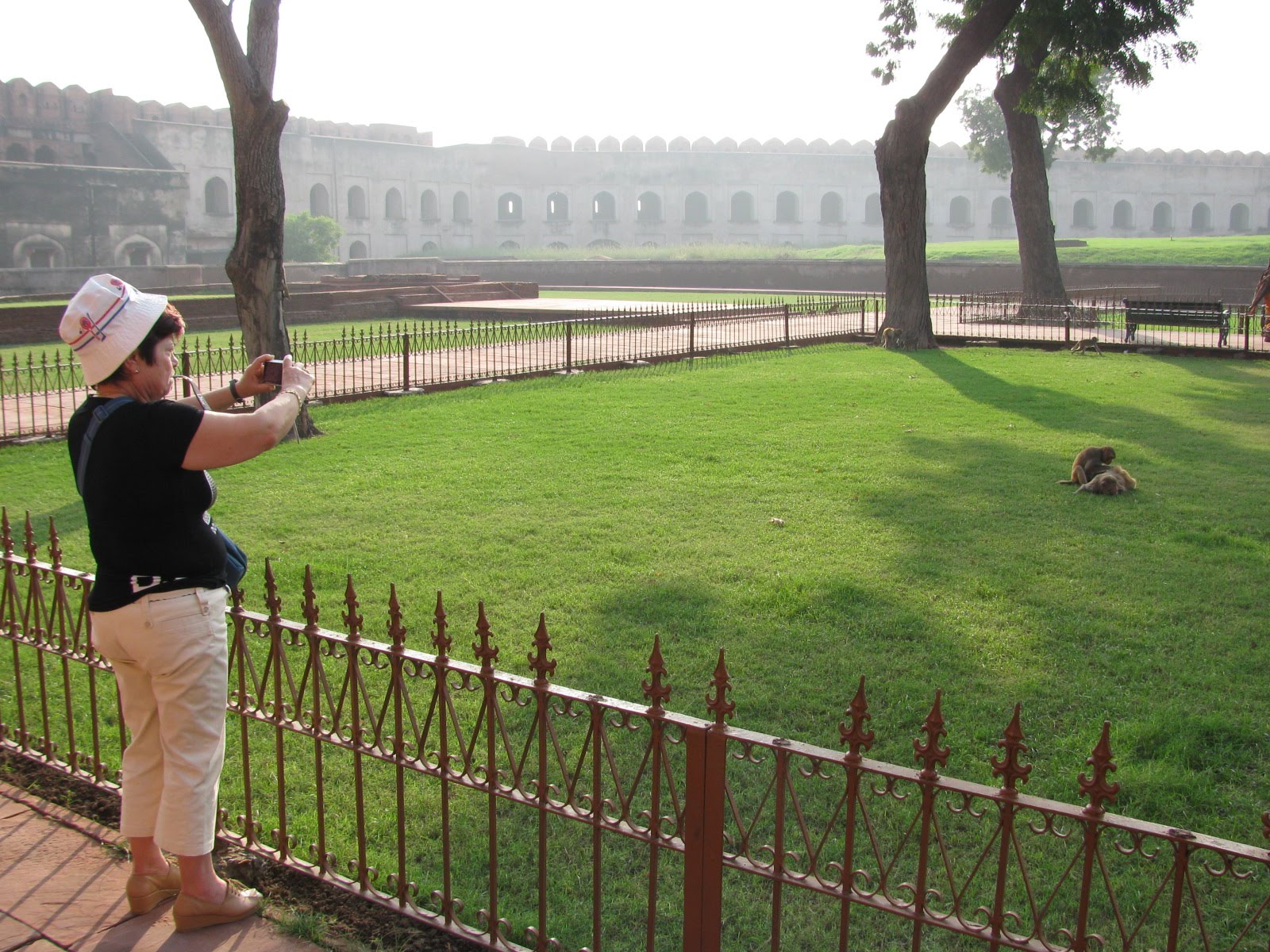
During our 36-hour stay in Agra, we also went to check out the Agra Fort, which happened to have a resident monkey troop. Upon our arrival, I was happily surprised to see a macaque reaching into a trash can and immediately went for my camera. At the same time, a tout offered his services as a guide to Danny. When he said no and walked away, the tout muttered something about tourists who just want to take photos of dogs and monkeys. Sure, tourists want photos of dogs and monkeys – it’s not like we see this kind of thing every day at home! Furthermore, the reason we never accept guides is that they want to rush through the site, sharing information that may or may not be true (for Fatehpur Sikri, the guidebook notes that most of what is said about the ancient palace and fort is made up, since no one actually knows what many of the buildings were used for), while we just want to explore at our own pace, investigating where doors and stairways lead, and photographing monkeys for long periods of time.


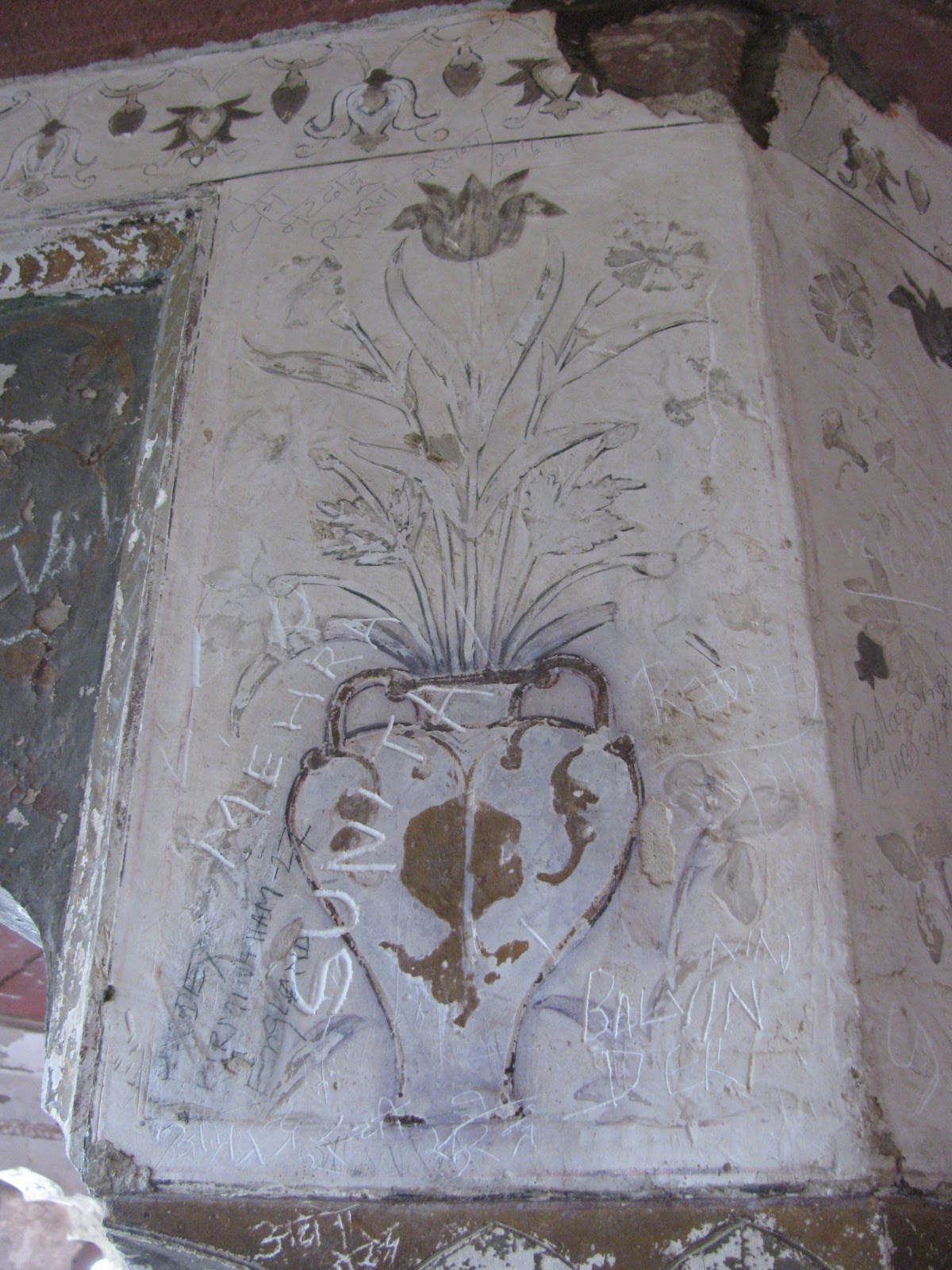
Like the Taj Mahal, there are some parts of the fort which were built with white marble and inlaid with semiprecious stones. One whole section is gated off, so as to preserve it and prevent the graffiti and theft of the stones that has happened in a similar section on the opposite side.



That evening, we headed out of town on a train to Mathura. Next stop: Vrindavan.

11.15.2009

Why is there graffiti on the Taj Mahal?

Our eleven-day journey began with a three-hour train trip to Uttar Pradesh, the state directly to the west of Delhi. Our first stop was Agra, home of the monument everyone has told me I had to see when in India: the Taj Mahal.


Our hotel was literally steps away from its eastern gate, and while we couldn’t actually see the domes of the Taj from our hotel, we could hear the singing that emanated from within at nearly all hours of the day (and sometimes night). We got up painfully early to try and beat the crowds, which the guidebook claims start to arrive around midday. (Everyone must read this advice, as it was rather busy at 7am.) The Taj Mahal charges a hefty Rs.750 (US $15) entry fee, which we actually had to go a whole kilometer down the road to buy, since they don’t sell them at the east gate. The ticket came with a free bottle of water and free shoe covers, though, which are two of the handful of items that are allowed to be brought into the grounds. The official word is that you’re only allowed to bring a small bag, camera, money, and mobile as long as it’s switched off, and you’re definitely not allowed to bring in pens or tripods.

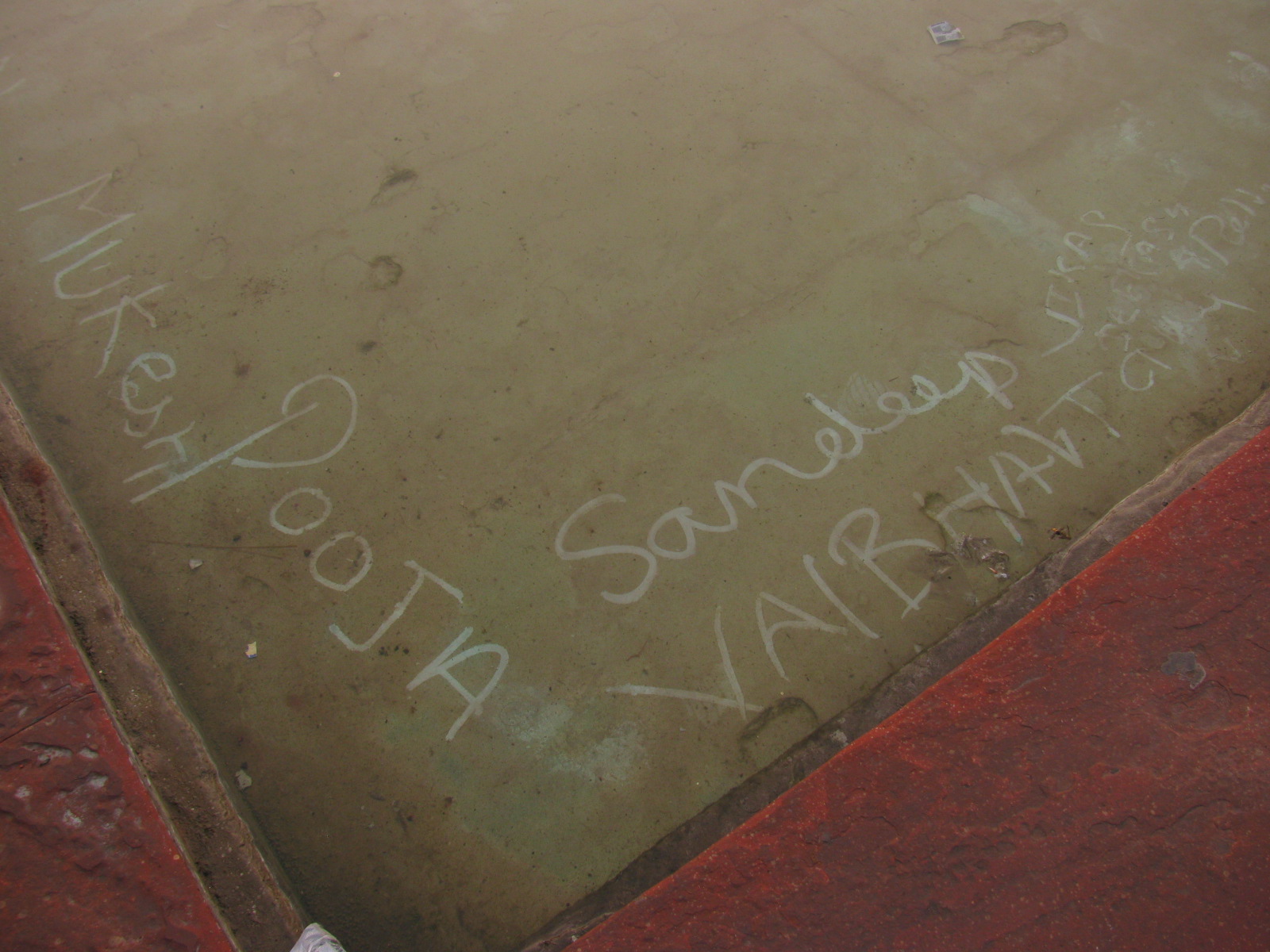
This is due to the depressing habit of defacing historical monuments that people seem to have here. At every site we’ve gone to, popular or not, from the Hawa Mahal in Jaipur to the zoo in Delhi, there is graffiti written or scratched into the walls, red paan spat into corners and in corridors, and even sometimes shit and piss stains in dark corners. From what I’ve heard, the blame is often placed on the Western tourists; however, the graffiti tends to read “Ravi from Bihar,” “Mehra loves Sunita,” or is written in Hindi, and I don’t know any Westerners who chew paan. It’s both sad and frustrating to come to these places and see how little respect people have for them. I personally can’t imagine going to a beautiful and ancient building and wanting to carve my name into it, either at home or abroad.


Even on the Taj Mahal, India’s crown jewel of historical sites, which also happens to be a mausoleum, there were names written in ink on the white marble walls. All it seems that can be done to prevent further damage is to restrict what is brought in and by placing guards who search and inspect each and every tourist as they enter the gates. What these places also need are guards throughout the grounds, as well as restoration of areas that have been destroyed. It’s my understanding, though, that there just isn’t the money to implement those sorts of measures, partly due to a lack of funds and partly due to corruption within the organizations that are in charge of taking care of India’s historical sites.


I wonder, though, about the general disrespect that seems to be shown toward these places. Are people so detached from their own history that they can justify leaving marks or poorly treating their monuments?


We spent the morning exploring the Taj and its grounds. A haze of smog sat over the city that morning (except for a ten-minute period when it briefly burned off), making it not so great for taking photos. But after seeing its image practically everywhere for years, from the internet to posters, I was actually not particularly moved by it. Yes, it’s a beautiful building, and I admire the amount of work that was put into creating a memorial for a loved one. I was expecting to be blown away, though, and I wasn’t. I think perhaps that I’m less impressed by the big (literal and figurative), famous, man-made must-sees. When I was in Paris nine years ago, I saw the Mona Lisa at the Louvre, surrounded by tourists taking its photo, and I just moved on, thinking, “It’s really small.”


Maybe that’s the attitude that the people take when they graffiti on the Taj Mahal. Maybe they think, “What’s the big deal?”

11.13.2009

The day Paharganj closed

After an exciting morning of packing for our upcoming trip to Uttar Pradesh and Rajasthan, we headed out to grab a bite to eat. Instead of the bustling madness of a typical Paharganj afternoon, it was actually quite mellow along the Main Bazaar. We soon realized that this was because the majority of the shops and restaurants were shut, despite it being nearly two in the afternoon. We ran into Danny's friend Raju, who is a bike rickshaw-wallah, and he told us that shopkeepers were on strike today in protest of a raise in the prices of food. (Strangely, though, I haven't been able to to find an article on this in any of the online Indian newspapers.)


One restaurant was open, and it looked like it was doing good business, being that it was the only one up and running in the vicinity and there were many hungry tourists who wanted lunch. After a very reasonably priced thali (Rs. 40 or US $0.90 for a plate of veg curry, dal makhani, aloo muttar, rice, dahi, and chappatis), we went back out to find that the shops were beginning open. I guess the need to make money supersedes the need to protest having to spend more of it. Most of them, though, remained closed, their metal storefronts pulled down and the shopkeepers biding their time elsewhere – like the men who were playing cricket in the street outside some closed shops.


The strike actually made it almost easy to walk down the street. There were less people and less vehicles trying to make their way down the narrow lane. It wasn't any less dirty, though, thanks to a morning rain shower, and there were puddles and mud along the side of the road where we walked.


We also took a tour of the neighborhood which surrounds the tourist trap of the Main Bazaar. The streets become even narrower, as the buildings tower overhead. The architecture and quality of paint differ from structure to structure. Sometimes there are distinct differences between floors of one building. While much of the main street had continued to be closed, most of the small neighborhood chaat stalls and paan shops were open for business, providing the locals with their "daily needs" of cigarettes and samosas.


********************

Tomorrow Danny and I are headed for an 11-day journey to see the Taj Mahal, visit some monkeys who are friends of Krishna, check out the Galta monkey temple, and experience the Karni Mata temple. I don't know what internet access will be like while we're on the road, but if I don't get a chance to post while we're there, I will definitely do so when we get back.

11.11.2009

Tuesday at the Hanuman mandir

The Hanuman mandir in Delhi is just off of Connaught Place. Commonly known as "CP," the mostly high-end shopping and eating district is a magnet for tourists who want to buy department store goods, organic teas and socially-conscious clothing, and over-priced trinkets. Meanwhile, the mandir, since it doesn't appear in any guidebooks, doesn't get a single tourist. It does get plenty busy, though, on Tuesdays, which is Hanuman's day and a particularly auspicious day for Hanuman worship.


On Tuesdays, the grounds of Delhi's Hanuman mandir are teeming with people: those who have come to do puja in the temple, those who have goods to sell (religious trinkets, chaat, or fruit and flowers to offer the gods), and those who have come to beg. Just outside the temple itself sits a row of elderly beggars, who wait for offerings of food or rupee coins from pilgrims. Further down the courtyard are a row of lepers, who come out specifically on Tuesdays to hold out their ruined hands for money. Children also approach people to ask for rupees. It's overwhelming to be surrounded by so many people who have next to nothing when you have so much in comparison.


Around the back of the temple complex, the macaques hang out outside the police station and an apartment complex. While people wait for handouts at the temple, the monkeys are showered with prasad, including bananas, burfi, and strings of marigolds. Unlike the macaques up in Shimla, these guys are less robust, not as furry, and smaller in size, but they appear to be well-fed. They don't know any of the item-snatching tricks and are less fussed about humans looking at them (and taking their photos). They do know a banana when they see one, though, and aren't afraid to approach a human to claim it for themselves.


While we were exploring the vicinity, we ran into a langur-wallah, who is a fellow with a trained langur on a leash. They walk around, chasing off bothersome macaques. I'm not sure if this keeps the macaques from creating further problems because, while they seem nervous about the langur's presence, they don't stay away for very long.


*******

We've switched to Hotel Prince Polonia in Paharganj, which we like much better than Ess Gee's. It's a little more polluted and therefore stinkier in this neighborhood, but there's wireless: I can blog from the hotel room while listening to NPR on streaming radio! In a city of many frustrations and disappointments, this is a big deal to me.

11.06.2009

Returning to Delhi

As we drove further and further from Shimla, it was obvious that we were getting closer to Delhi. Kalka, the first large town in Himachal that we came to after leaving the foothills, was full of trash in a way that we hadn’t seen in the last seven weeks: there were piles of garbage everywhere, mostly consisting of plastic bags, with cows and pigs picking through it all for something to eat. As the hours and miles passed, the air started to take on a smell that is particular to Delhi, one that is a mix of sewage, smog, shit, sweat, and exhaust. We got stuck in traffic numerous times and witnessed the aftermath of two different highway accidents. (Danny also saw two dogs that had been run over in separate incidents.)

We’re staying at Ess Gee’s guest house, in the Patel Nagar neighborhood, which has actually turned out to be a disappointment. The room itself isn’t terrible, for India standards. Despite the dirty floor that turns my feet brown when I walk around barefoot, really slow shower drain, sticky geyser handle on the toilet (yuck), crappy channel options on the TV, two single beds separated by a nightstand instead of one double bed, and the occasional visit from a large cockroach or mouse, it’s actually quite roomy, has an air conditioner, and is located in a nice neighborhood. Unfortunately, we were expecting more from the hotel, and it hasn’t delivered. The breakfast, included in the room rate, is standard, boring white toast and eggs – from chickens, based on how my boiled eggs tasted the first morning, that may have been raised on garbage. Plus they skimp on the butter for the toast. The hotel’s website claims it has a business center, with internet and long-distance calling facilities. It turns out that was blatant false-advertising, since there is nothing of the sort on-site. They also charge exorbitant amounts for laundry. At Rs.20 per piece, it cost us nearly twenty dollars to do a load of laundry – and that’s partially because they charged per sock! Meanwhile, the “boss” is a disembodied voice who lives somewhere on one of the upper floors and is only available by telephone – his staff takes care of everything, and he never even asked us to check in properly. Makes you wonder if the place, which doesn’t even have a sign board outside, is even a legitimate hotel.

There was another hotel that we’d been interested in. For an extra 100 rupees per night, it has wireless, fridges in-room, a rooftop cafĂ© with room service, and most likely has a real-live person at a real-live reception desk. The only reason we didn’t go with that place to begin with was because it’s in Paharganj, where Danny was hesitant to stay in. Paharganj is the hot-spot for backpackers, hippies, drug dealers, beggars, filth, and low-budget digs. Hotel Prince Polonia, which we plan to check out this afternoon, is definitely not a budget hotel (not at Rs. 1200/night!) and is also a little bit off the main drag – and so we’re hoping the facilities will make up for its location.


While I wouldn’t walk around Paharganj by myself at night, I actually kind of like it there – although I’ve only spent small amounts of time there, watching the traffic move by while I was sequestered in the safety of a restaurant. It’s a great place for cheap eats, which are hard to find in Delhi, and the people watching can’t be beat. I especially enjoy critiquing the outfits of the tourists who are generally trying too hard or have been convinced by a shopkeeper that their purchase will help them fit in. The shops, which are most definitely geared toward tourists, are also fun to look at, provided I’m at a distance where I’m not going to be shouted at: “Yes, madam? Madam, looking is free.”

Paharganj might be an interesting place to stay. It seems as though every other young traveler to Delhi, including Danny, has stayed there at one point or another. If nothing else, it’ll give me something to write about.

11.03.2009

Good-bye to Shimla

On my last day in Shimla, I got climbed on by a female monkey trying to eat pieces of apple off of my head and also had a huge male monkey eat hazelnuts out of my hand with his mouth. Danny and I said good-bye to all the people we knew at the temple, including the temple dogs (Sheru, Lusi, Dreadlock Dog, Dusseri Lusi, and Spot). We had dinner at my favorite restaurant and ate way too much. And soon, we'll be headed back to the hotel to pack up all our stuff.

It’s time to say good-bye to Shimla and its monkeys. Tomorrow we leave for Delhi, where the macaques are fewer and far between. We’ll spend the next seven weeks splitting our time between living in Delhi  and traveling to a few other cities, including Agra and Vrindavan in Uttar Pradesh, Jaipur and Bikaner in Rajasthan, and Kolkata in West Bengal. In Delhi, Danny will continue with his research, and I’m hoping to volunteer with Mother Teresa’s Missions of Charity, helping to take care of orphaned babies.

It’s not the end of our animal adventures, though: there are bears in Agra, more macaques and langurs in Vrindavan and Jaipur, camels and sacred rats in Bikaner, and monkeys, elephants, rhinos, and tigers in Kolkata. Add the famous sights we’ll see (the Taj Mahal, Fatehpur Sikri, Raj Ghat, the Karni Mata temple), as well as all the foods we’ll be eating (Gujarati thalis, Mughali koftas, freshly-caught fish curries, camel-milk lassis!) – and suffice to say, there will be much to report on this second leg of the journey.

I will definitely miss the monkeys (even the ones who stole my glasses!), the cows who roam the streets and moo insistently for snacks at shop doors, and the friendly stray dogs. I’ll miss being able to walk down the street without worrying about being run over by a car and having everything from restaurants to chemists within easy walking distance. I’ll miss the chow mein at China Town, all the fabulous dishes at Nalini and Fascination (we had the most amazing fish tikka there last night), and even the dal makhani and naan “mini-meal” at Himani (where the table linens look like they’ve been washed with coal). I’ll miss hiking up Jakhu hill to the mandir, partly because it’s been my only form of exercise since I got here!

I won’t miss how cold it’s gotten here, though I don’t think I’ll like the 30°C weather in Delhi any better. I definitely won’t miss our mildew-covered, cramped hotel room, nor will I miss the smell of our bathroom, which actually lets in some of the sewage smells through the toilet, particularly at night.

Danny pointed out to me that there will be things I miss about Shimla once I’m actually in Delhi. The quiet, for instance. Compared to the constant din of Delhi, Shimla’s nights are calm, interrupted only occasionally by the distant bark of a dog, an ambulance siren, or music from a late-night wedding. The air here, despite being thin due to the high altitude, is fresh, unlike the brown, polluted smog of Delhi. (Danny told me that he’d heard breathing Delhi’s air is like smoking a pack of cigarettes a day. In fact, on the news this past weekend, they reported that Delhi’s air pollution levels are dangerously high right now.) Also, the people here are generally friendly and no one is trying too hard to cheat me out of my money, unlike in Delhi, where touts, rickshaw drivers, beggar children, and shop-wallahs will try to squeeze every last rupee out of me.

So it’s off to the craziness of Delhi. Good-bye, Shimla. Perhaps I’ll be back someday.

11.02.2009

Monkey birth control

One of the methods being implemented to reduce the macaque population is sterilization. With dogs here in India, it’s a fairly straightforward process: someone catches the dog, another person does the sterilizing (usually a vasectomy or tube-tying), and then the dog is released. The dog receives a notch in its ear, to mark it as having been fixed. With monkeys, the process is similar… but a little more complicated.

I went with Danny to what is commonly referred to as the Tuti Kandi Zoo, but which is actually called the Rescue & Rehabilitation Home and Monkey Sterilization Centre. It’s located in Tuti Kandi, a village just outside Shimla, and it was a zoo, once upon a time, but now houses rescued and captured leopards, Himalayan bears, and rhesus macaques. In bare-bones cages with concrete floors live about a dozen bears and four leopards, which were brought in injured and subsequently treated by the resident vet. If the animal heals within a short period of time, it is released back into the wild, but if the recovery period is longer, it has to stay at the center, as they have no facilities to help the animal become re-accustomed to the wild. So a number of bears and leopards are permanently housed at the center, because of concern that once the animals have become used to contact with humans and human-provided food, they will seek out human habitats instead of staying away from villages.


With the macaques, it’s a little different. When monkeys are captured and brought to the center, it is specifically for the purpose of sterilization. Once they arrive, the sterilization procedure is performed as soon as possible, sometimes even the same day, and the monkeys are returned to where they were caught within a week.

Depending on how many monkeys are captured, as many as two dozen or more are sterilized every day. Danny observed the sterilization process, during which the doctor uses a laser to make a small incision in the macaque’s abdomen, then uses a small camera to show him just where to make the cuts. During the procedure, I remained in the prep room. I watched assistants bring in knocked-out monkeys and pile them on every space inch of counter space. Meanwhile, one assistant applied an antibacterial solution to the monkeys’ bellies, and then made quick work of their fur with a shaving blade. The monkeys were then transferred to a table by the operation room, where they waited their turn to be sterilized. At one point, I was surrounded by about ten monkeys, their eyes half-closed and their gaping mouths showing off sharp teeth.


Before and after sterilization, the monkeys are housed in a building filled with rows of small cages. Some care is taken to keep mothers with their babies or seemingly related juveniles together. It’s not the best of facilities, and the monkeys express a range of emotions about being kept there, from despondency and depression (some lean listlessly against the sides of their cages or lie on the uncomfortable mesh bars that line the floors) to fear and anger (making threat faces at humans or screaming at each other). Many monkeys carry fresh wounds, from being transported to the center in a small cage with several other monkeys – or from their human captors who aren’t exactly gentle with them. One large male had lost the tip of one of his fingers, while another smaller male had lost an entire portion of his face: his lip was ripped open and his nose was all but missing. Others had gashes in their backs or arms.


While I understand the potential good that sterilizing the monkeys will do, it’s hard to see them in such squalid facilities, crying, scared, and huddling with babies or friends. It’s partially a lack of money and partially a lack of proper animal-handling knowledge or training – or perhaps simply a lack of respect for the monkeys. Any animal rights group would have a field day with the center, as they probably would with any place in India that houses animals, including the zoos. I have to remember that the center is doing what it can to reduce the area’s monkey problem and, being that it is a government-run program, that it can only provide bare-bones care and facilities.


Bringing the monkeys to the center is a process that involves a lot of patience. Danny and I followed the resident animal catcher as he and his team of three young Nepali men went about the business of trapping macaques. The boys start by setting up a large metal cage, which has a trap door at one end and a small gate on the side. One of them is put on trap door duty, and he sits at a distance, holding the twine that allows the door to drop when the time comes. Another one of the boys scatters foodstuffs – bread, bananas, peanuts – in the cage and in the surrounding area. He calls to the monkeys as he does this, saying, “Leh, leh,” or “Au, au,” which are, apparently, known ways to get the attention of the monkeys.


Then the waiting begins. Everyone stands back, while the monkeys investigate. In the villages, where it’s more wooded, the monkeys are harder to trap because they are more wary. We watched some rural macaques hesitantly approach the cage and the food, then take off at the slightest sign of something suspicious. In the city, it’s easier to catch the monkeys because they’ve grown soft and lazy with the easy access to food afforded them by humans. Food is abundant in garbage dumpsters and littered along the side of the road, and humans are easy enough targets for the stealing of bananas or ice cream cones. No danger is too risky for a city monkey who really wants to fill his cheek pouches with peanuts.


Sometimes one monkey enters the cage, or even two or three or more. Then the boy drops the door, which falls with a terrific crash. The monkeys freak out, bouncing off the cage walls or going to the smaller door and trying to pull it open. The guys put a small cage next to the large one and open the small door for the monkeys to go through. Using long sticks to encourage them toward the door (these three were actually rather gentle with the monkeys), the monkeys eventually find their way into the small cage. Then the large door is pulled back up, and the process begins again. One early morning, we watched about a dozen monkeys get captured in this way, while the rest of the troop watched anxiously from the surrounding trees and the government building behind us.


Meanwhile, the captured monkeys, who are understandably frightened, fight amongst themselves – especially if a large make is being held captive with several lower-ranking macaques – but eventually simply huddle together and poop. (When they finally moved the small cage full of monkeys, there was a huge pile of droppings left on the ground.) In the village, one female was so scared, she opened her mouth and began vigorously patting her cheeks, releasing all the food she’d been storing in her pouches. In the city, however, the monkeys continued to eat, despite their fear.


When they feel they have caught enough monkeys, the small cages are loaded into the back of their truck, and the cage is dismantled. Then it’s off to the next location to collect more monkeys.


When it’s time to return the macaques to their habitats, post-sterilization, they are once again stuffed into small cages and driven back to where they were caught. In an unceremonious procedure, the cages are opened one by one, and the frightened monkeys bolt from the van as fast as their little feet can carry them. They rejoin their troops, where they probably have to spend some time sorting out rank

It’s a fascinating process. But is sterilization working? Of the nearly five hundred monkeys living up at Jakhu, the monkey trappers caught about forty – that’s less than ten percent that are being preventing from further breeding. The sterilization program has been going on for five years, and we still see just as many infants and juveniles as we do adults. Dogs, on the other hand, seem to not be producing as many puppies, as we have only seen four little ones and maybe a hundred adults the entire time we’ve been here. This may be because dog sterilization is handled by the Municipal Corporation, while monkey sterilization is the duty of the Forrestry Department, which is spread much more thinlyover its jurisdiction. I know Danny wants to come back sometime soon to do further investigation into whether the sterilization process can be successful at reducing the monkey population.