1. At any time of day and provided you have cable, you will be able to find Amitabh Bachchan, the biggest classic movie actor and one of the most famous faces in Bollywood, on at least two channels. Shah Rukh Kahn, Bollywood’s current big name, might found on at least one channel, even if it’s just in a commercial for satellite TV.
2. Celebrities are so big in India that they regularly are featured in “breaking news” segments. One day, the news included a piece on whether Salman Khan’s biggest nemesis was Shah Rukh Kahn or Aamir Khan (yes, all of the most famous contemporary actors have similar last names but are unrelated). Actors are such a big deal here that their opinions are listened to and considered seriously when they are expressed on politics, society, or other current events – to the point that these opinions often make front page news. (Actors are so big, in fact, that scandals don’t affect their careers. People still love Salman Kahn, despite the fact that he has, in the past, been involved in domestic violence, the hunting of an endangered species of deer, and the killing of a pedestrian while driving drunk.)
3. The two most prevalent beauty concerns for women are achieving fair skin and preventing “hair fall.” At least one commercial per break involves some kind of cream that promises to fade freckles and to “brighten” skin tone up to two full shades. The brands are all ones that I’m familiar with at home: Garnier, Dove, Pond’s. They promise skin that will bring you fame, love, and beauty. When I went to a drug store to buy shower gel, the woman working there tried to sell me a lightening cream – because she immediately noticed that I have freckles! Imagine what Indians would think of Americans’ obsession with skin tanning products.
I’m not so sure why advertisements for hair products are so focused on women losing their hair. I suppose that because long, thick hair is highly valued in women, losing a few strands in a hair brush can lead to the worry that one is losing a ton of hair. I do wonder if “hair fall” can more likely be attributed to poor nutrition, rather than what products are being used – which can be contributed to a diet that is more Western (read: abundant amounts but low nutrient value, such as McDonald’s). As with skin lightening creams, all the major brands are taking advantage of this primarily female concern: Pantene, Dove, and Garnier especially.
4. Good wives wait at home, doing the cooking and cleaning, while the husband goes out to work and lives the high life with friends and colleagues. Modern-day India apparently is a lot like the U.S. in the ‘50’s.
There is a type of cooking oil called Husband’s Choice, the idea for which is that it includes important nutrients for the male body – because, of course, a woman will be cooking for her husband and all the male members of the family, and it is her priority to keep them all healthy. (On a related note, oils are so highly valued as a source of nutrients in the Indian diet that they get their own group in the four food groups: fruits and vegetables; beans, meat, and dairy; grains and pulses; and oils and nuts.)
5. In stark contrast, the young women of Bollywood bare a lot of naked skin and often act silly and brainless – kind of like many young women in Hollywood. Instead of the glamorous actresses of yesteryear in saris or embellished kurtas, contemporary actresses wear tube tops, miniskirts, and stilettos. That may not sound too terrible, but in a culture where women are expected to dress modestly, men stare at them anyway, and to talk about sex is still fairly taboo, the move to “Westernize” Bollywood actresses in a stereotypical way does nothing but perpetuate the idea that Western women are loose and stupid – and so now, too, are these Bollywood actresses. To further emphasize the stereotype, female actors speak in higher-pitched voices, punctuated with giggles. (Men speak in deep voices, to emphasize their masculinity.)
6. I love watching infomercials (no matter where I am), and my favorite one here is for jewelry that is meant to deflect the evil eye. I always thought the evil eye was an old wives’ tale, but I guess here in India, people really believe it exists – and that you can inflict it upon someone without meaning to. How it seems to work, according to the infomercial, is that when someone compliments you (or your child or your new business), their hidden jealousy manifests itself as the evil eye, which then afflicts the person with ill health, an accident or fire at their place of business, or some other incidence of bad luck. The infomercial sells a set of jewelry with a large glass bead of varying shades of blue, which includes a bracelet, necklace, and amulet (to hang in a room) – all of which are “scientifically” guaranteed to keep off the evil eye. For just under Rs. 3,000 (US $60), you, too, can have a lovely glass pendant to protect you from, well, everyone. (Actually, I think it’s really pretty and would buy one on a necklace if I saw someone selling it for, say, Rs. 200.)

10.08.2009
Visiting the bird house
One afternoon last week, we took a couple-mile walk out in the direction of the Viceregal Lodge and Himachal Pradesh University. The journey was filled with the typical gorgeous views of the Shimla as the outer reaches of the city stretched out into more wooded areas. It also included, of course, the occasional macaque crossing the road and a tree full of langurs.


When we reached the Viceregal Lodge, we noticed that right across the way was the
In the front room before the aviary, there was no one to collect the entrance fee (all of Rs. 5, plus Rs. 15 for my camera) but the head of a small ungulate mounted on the wall. I cringed and, not wanting to spend more time than I had to in close quarters with a taxidermied animal head, pushed open the door into the bird park – where I found that one entire wall was dedicated to taxidermied animals.
For those of you who don’t know, I have a severe phobia of taxidermy. When I was growing up, the African safari room of my beloved California Academy of Sciences was both intriguing and terrifying to me. Provided I had my mom’s or dad’s hand to hold, I was comfortable peering through the glass at the zebras, lions, and various kinds of antelope, posed at the drinking hole or looking off into the distance. One visit, though, I went with my mom’s best friend’s family, and since I was too embarrassed to admit my fear, I hung out with a small exhibit off the African safari room and got to know really well a replica of Lucy. The animals at the
Unfamiliar taxidermy exhibits continue to freak me out. A few years ago, on a trip to Manhattan’s American Museum of Natural History, I had to hold onto a friend’s arm until I felt comfortable being surrounded by the stuffed animal skins with glass eyes. And a couple months ago, when we were camping at Big Sur, we came across the nature learning center, which was, fortunately for me, closed – because it was full of taxidermied animals. Even just looking at them through the window in the front door was unnerving.
Even worse is bad taxidermy: poorly constructed, dusty, falling apart, or just simply ageing animals not only are horrible to look at, but they really scare me. That’s the kind of taxidermy they had at the bird park – according to Danny anyway. I barely took a good look at the pieces (I saw the rear end of a yak and a couple large deer on one end and a leopard on the other) before I moved away into the area where the birds were. My fear was bad enough that I refused to even walk past them with my eyes closed and Danny leading me past. Fortunately, the bird park was built with circular path, so I just went the wrong way to look at the birds. Also, from the upper level of the aviary, I couldn’t see the taxidermy exhibit below, since it was blocked by tall foliage, which some of the birds lived in.


The bird park is home to a number of geese, red jungle fowl (from which all chickens in the world are descended from), pheasants, monals, and the occasional sparrow. We were the only ones visiting at the time, and apart from two men who were doing some work, it was just us and the birds. Which was kind of nice, actually, since normally everywhere in


When we reached the Viceregal Lodge, we noticed that right across the way was the
In the front room before the aviary, there was no one to collect the entrance fee (all of Rs. 5, plus Rs. 15 for my camera) but the head of a small ungulate mounted on the wall. I cringed and, not wanting to spend more time than I had to in close quarters with a taxidermied animal head, pushed open the door into the bird park – where I found that one entire wall was dedicated to taxidermied animals.
For those of you who don’t know, I have a severe phobia of taxidermy. When I was growing up, the African safari room of my beloved California Academy of Sciences was both intriguing and terrifying to me. Provided I had my mom’s or dad’s hand to hold, I was comfortable peering through the glass at the zebras, lions, and various kinds of antelope, posed at the drinking hole or looking off into the distance. One visit, though, I went with my mom’s best friend’s family, and since I was too embarrassed to admit my fear, I hung out with a small exhibit off the African safari room and got to know really well a replica of Lucy. The animals at the
Unfamiliar taxidermy exhibits continue to freak me out. A few years ago, on a trip to Manhattan’s American Museum of Natural History, I had to hold onto a friend’s arm until I felt comfortable being surrounded by the stuffed animal skins with glass eyes. And a couple months ago, when we were camping at Big Sur, we came across the nature learning center, which was, fortunately for me, closed – because it was full of taxidermied animals. Even just looking at them through the window in the front door was unnerving.
Even worse is bad taxidermy: poorly constructed, dusty, falling apart, or just simply ageing animals not only are horrible to look at, but they really scare me. That’s the kind of taxidermy they had at the bird park – according to Danny anyway. I barely took a good look at the pieces (I saw the rear end of a yak and a couple large deer on one end and a leopard on the other) before I moved away into the area where the birds were. My fear was bad enough that I refused to even walk past them with my eyes closed and Danny leading me past. Fortunately, the bird park was built with circular path, so I just went the wrong way to look at the birds. Also, from the upper level of the aviary, I couldn’t see the taxidermy exhibit below, since it was blocked by tall foliage, which some of the birds lived in.


The bird park is home to a number of geese, red jungle fowl (from which all chickens in the world are descended from), pheasants, monals, and the occasional sparrow. We were the only ones visiting at the time, and apart from two men who were doing some work, it was just us and the birds. Which was kind of nice, actually, since normally everywhere in
10.07.2009
Trout for dinner
As I mentioned elsewhere, I haven’t really been eating meat since I’ve been in India India
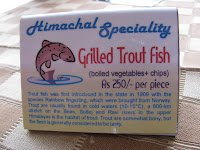

We stopped in at Ashiana for lunch one day, and on every table was a little sign advertising “grilled trout fish.” Included was a description about trout: “Trout fish was introduced in 1909 with the species Rainbow fingerling, which were brought from Norway. Trout are usually found in cold waters (10-15°C), a 600-km stretch on the Beas, Sutlej, and Ravi rivers in the upper Himalayas is the habitat of trout. Trout is somewhat bony, but the flesh is generally considered quite tasty.” For Rs. 250 (US $5), the grilled trout came with chips and boiled vegetables. It was the most expensive meal I’d had in a while, but it was probably a quarter of what I’d pay at home and, as it turned out, totally worth it.

We each got a whole trout, with a crispy grilled skin and a little bit of masala sprinkled on for good measure. The fish was rather bony, even after I removed the spine, but again, worth the effort to pick out the tiny bones. As promised, there were a few masala-dusted fries and a spoonful of boiled-then-grilled vegetables on the side. It didn’t look like a lot, at least in comparison to the huge portions I’d get at home, but the serving size was perfect. In the end, all I had left was a plate of fish bones, and I was full and happy.

I’ve been doing some travel planning, and I’m hoping to make it out to Kolkata toward the end of my time here in India. I want to see it partly because I’d like to experience a big city in a part of the country I’ve never been to, and partly because my grandfather spent some time in Calcutta when he was stationed in India during WWII (and I want to photograph things he took photos of). As a bonus, West Bengal, the state Kolkata is in, sits on the Bay of Bengal, which means a lot of the food includes fish: fish curry, fish pakora, jhaal (fish with ground mustard seeds and chilies), and chingri malaikari (giant prawns, which the guidebook says are so big that they “speak lobster,” cooked in coconut milk). It has the makings of an awesome trip.
10.01.2009
Chinese food in India
Before I left for India, I was reading a book by Jennifer 8. Lee called The Fortune Cookie Chronicles, in which, among other things, the author explored the history of the fortune cookies, as well as took it upon herself to find the best Chinese food in the world. (Seriously, how do I get this kind of job?) She talks about the ways in which Chinese food manifests itself in different countries, based upon the various tastes of those particular parts of the world.
I’ve had Chinese food in numerous countries, including several European countries (England, Hungary, Italy, the Netherlands), Mexico, and Thailand. Each puts its own spin on how Chinese food ought to be. (Don’t eat Chinese in Hungary. Really.) India, too, has its own regionally-inspired Chinese cuisine. It’s very popular and can be quite tasty.

The dish that intrigues me the most is chop suey. To begin with, it’s not pronounced “chop soo-ey” like we say in the States. Here, it’s pronounced “chop see.” It is typically found in the “Chinese” section of nearly every menu, including our hotel’s, next to the chow mein. The chow mein is similar to what we have at home: an oily pile of thick egg noodles, with some veggies or egg thrown in. The chop suey is an entirely different beast. It comes with a tangle of crisp, thin noodles, submerged in an almost too-sweet tomato-based sauce, dotted with vegetables. To be honest, I’ve never actually had chop suey at home, due to its lack of “authenticity,” being that it was a dish invented for the American palate (read: the kind that enjoys eating Wonder Bread and vanilla pudding). I therefore have no basis of comparison to the “original” chop suey. But I find it interesting that this American-Chinese dish has found it way, in one form or another, onto the plates of Indians who enjoy Chinese food.


Besides Dim Sum, where one should only go for momos (as nothing else on the menu is particularly spectacular), we haven’t eaten at any Chinese restaurants here in Shimla. There are a number of tiny places on the middle bazaar, which were crammed packed the one afternoon we wandered down there for lunch. I’m curious to find out how the Indians up here in Himachal envision Chinese food. Being that China is just on the other side of the Himalayan mountains, one would hope that they can do Chinese well – in whatever form it takes.
We did have Chinese food when we were in Delhi, at a place in Connaught Place called Bonsai. It’s kind of off the main tourist drag, down a trashy, stinky street filled with parked cars and stray dogs. It was entirely empty when we arrived, which normally indicates the poor quality of a restaurant, but the food was actually really good. It was “happy hour” (which in India lasts from like noon to eight), and the beer and some dim sum were at half price. We had veggie spring rolls, veggie sui mai, broccoli and shiitakes in oyster sauce, and rice. The spring rolls were the best I’ve ever had in India, comparable to ones I had while in Bangkok: the outer skin was thin and crunchy, not doughy like at other Indian places. The sui mai was intriguing to me, as I’d only ever had sui mai made with pork and shrimp. The filling for the vegetarian version was a variety of diced veggies, which were really tasty, although the skins fell apart upon removal of the dumplings from the steamer which they were served in. They were served with an aioli of unknown origin, which was fabulous nonetheless (I ate the leftover mayo mixture on top of the leftover rice). The broccoli and shiitakes were also very good – the best stir-fried veggies I’ve had in India.


It’s interesting how Chinese food has made its way around the globe and gained widespread popularity. Danny commented that this could be due to the use of the savory or “umami” flavor, typically found in MSG (among other things), in Chinese foods that isn’t necessarily emphasized in other cuisines. Whatever the reason, I’m looking forward to further explorations of Chinese food in India.
********************
Happy birthday, Mom and Mike! I hope you're going to (speaking of Chinese food) a buffet tonight or this weekend, and I'm extremely jealous.
I’ve had Chinese food in numerous countries, including several European countries (England, Hungary, Italy, the Netherlands), Mexico, and Thailand. Each puts its own spin on how Chinese food ought to be. (Don’t eat Chinese in Hungary. Really.) India, too, has its own regionally-inspired Chinese cuisine. It’s very popular and can be quite tasty.

The most popular dish seems to be little dumplings called momos. Actually, I’m not entirely sure if they’re Chinese – they could be Tibetan. Regardless, these little pouches of dough-wrapped vegetable filling are on almost every menu at every restaurant we go to here in Shimla. At some places, you can get them steamed or fried, but typically, they come steamed. They’re best served with a trio of dipping sauces: soy, vinegar with tiny chopped chilies, and a red, fiery sauce filled with chili seeds. Many places, however, just serve them with Indian-style ketchup, which is less sweet than the kind at home. The filling varies, too, by restaurant. It’s primarily cabbage with wisps of other finely slivered vegetables, and sometimes they have bits of chili pepper thrown in for good measure. (There is a meat variation as well, which we haven’t tried.)


We did have Chinese food when we were in Delhi, at a place in Connaught Place called Bonsai. It’s kind of off the main tourist drag, down a trashy, stinky street filled with parked cars and stray dogs. It was entirely empty when we arrived, which normally indicates the poor quality of a restaurant, but the food was actually really good. It was “happy hour” (which in India lasts from like noon to eight), and the beer and some dim sum were at half price. We had veggie spring rolls, veggie sui mai, broccoli and shiitakes in oyster sauce, and rice. The spring rolls were the best I’ve ever had in India, comparable to ones I had while in Bangkok: the outer skin was thin and crunchy, not doughy like at other Indian places. The sui mai was intriguing to me, as I’d only ever had sui mai made with pork and shrimp. The filling for the vegetarian version was a variety of diced veggies, which were really tasty, although the skins fell apart upon removal of the dumplings from the steamer which they were served in. They were served with an aioli of unknown origin, which was fabulous nonetheless (I ate the leftover mayo mixture on top of the leftover rice). The broccoli and shiitakes were also very good – the best stir-fried veggies I’ve had in India.


********************
Happy birthday, Mom and Mike! I hope you're going to (speaking of Chinese food) a buffet tonight or this weekend, and I'm extremely jealous.
9.29.2009
Festival time
The Hindus in India just finished celebrating a nine-day festival called Navarathri ("nine nights"). The days are marked by late night processions with lots of singing, drumming, and the blowing of conch shells. It all ends with Dussehra, which commemorates the story of the Ramayan, when Lord Ram rescued his wife Sita from the clutches of the demon Ravan (with a help of his brother Lakshman, the god Hanuman, and an army of bears, monkeys, vultures, and Vanar princes) and when effigies of Ravan, his brother, and his son are burned to celebrate Ram’s success.
There was a big festival at Jakhu planned for Dussehra. Earlier in the week, we watched men building the demon effigies. They started by lashing together bamboo poles for the skeletons, which was followed by layers of newspaper and fabric. It reminded me of the Guy that is burned on Guy Fawkes Day in England or what I imagine they burn at Burning Man – times three.

Dussehra was yesterday, and we set out for the festivities after lunch. We were planning to take a taxi up the hill, instead of doing the hike, but trying to catch a cab was madness. Like many things in India, getting into a queue is a nice idea that doesn’t actually fulfill its function. We stood in line, waiting for the taxis to arrive. When one finally appeared, the people formerly in a line immediately surged forward, pushing and shoving to get in (while the original passengers were still trying to get out!), regardless of who had been there first. As you can see in the photo below, people are practically coming out of the windows – and still more are trying to get in the rear door. When this taxi went by, I saw that girls were sitting on each others’ laps, squished in like sardines. After waiting for forty-five minutes and deciding we didn’t want to have to fight anyone to get into a car, we decided to make the hike up after all.

There were more people than usual taking the path up to the temple. On an average day, there might be a young honeymooning couple or two, some aunties in saris, a few older gentlemen in sweater vests, a handful of teenagers in hip Western clothing and students in their school uniforms, and the odd Western tourist either going up or down the road. On festival day, there were hundreds: whole families in their very best saris and salwar kameez suits and button-down shirts, packs of young dudes, tourists in backpacks and brandishing cameras, and even some stray dogs from Shimla town who didn’t typically go up the hill. Even though Danny had brought his monkey stick, we didn’t really need it: the monkeys seemed too overwhelmed by the sheer number of humans to bother anybody.


Periodically along the path were vendors selling all sorts of festival day goodies. Normally, there is just a Tibetan woman selling shawls (I bought a couple really pretty ones from her last week) and a couple different people selling prasad, including an older woman I call Auntie Prasad, who pushes her wares on everyone who passes by (Rs. 20 for four packets of the white candy – and take two sets, because there are two temples), knits in the meantime, and talks to Danny in Hindi about monkeys and marriage and how she’d like to see me wearing a salwar kameez. None of the usual folks were there, though. Instead, there were people selling plastic flowers, bhel puri (fried puffs of dough that are, as Danny says, “filled with sickness”), and pillow cases with portraits of tigers on them. As we got closer to the temple, the path became lined with vendors selling a variety of street food (including pakora, jalebi, sandwiches of little fried patties, neon-colored cotton candy, and melting kulfi), as well as all kinds of toys for the children.


There were your typical dolls, toy cars and trucks, pop guns, and other assortment of cheap, plastic junk. For the festival, they were also selling Hanuman masks and the various weaponry used to defeat Ravan and his gang: the bows and arrows of Ram and Lakshman, the club of Hanuman, and swords, all covered in bright, shiny paper. Among the festival toys were masks of Krish, “India’s first superhero,” and Spiderman – just in case, I suppose, you preferred to dress up as something more secular.


The entryway to the temple grounds were decorated in silver and gold tinsel, hanging above our heads. The prasad sellers were out in full force, though there was not a monkey to be seen. We arrived just as the chief minister (similar to a governor back in the States) of Himachal Pradesh was leaving the Shiva temple to go up to the Hanuman temple. There were police officers everywhere because of this, more than I’d ever seen in one place at one time. After Danny bought some prasad from some vendors he knew, we headed up, too, and tried to find a good place to watch the festivities. There were people everywhere: crammed along the edge of the hill, crowded around the outside the temple itself, even up on the scaffolding where normally people were renovating some of the buildings. Danny estimated that there were probably nearly 3,000 people gathered to watch Ravan burn. We ended up standing on the edge of a planter box full of marigolds and barbed wire (to keep out the monkeys). Fortunately, the barbed wire they use around Shimla is fairly harmless; it doesn’t even stop the monkeys.

Ravan and his demon compatriots were set up at the bottom of the first slope beneath the temple (which I thought was a bad set-up, since everyone was above, trying to look down, and still having their views blocked by everyone standing in front of them). The effigies were pink-skinned, with curling mustaches, crowns, and swords. Ravan came complete with his ten heads. At one point, the cast of the Ramayan walked down into the gully where the effigies stood, though what they did after that is a mystery to me, since I couldn’t see down that far. Meanwhile, people were burning huge sparklers and setting off fireworks, which all went off with loud and sometimes disconcerting bangs.


I have to admit that I was a little nervous about three paper-and-bamboo demons being burned in the middle of a pine forest, but they’d done this before and all of the two firemen present would most certainly assure the safety of the trees. I can’t even imagine what would happen if a forest fire broke out with a crowd of thousands present. Crowds in India are not well known for their level-headedness in an emergency. In fact, last year at the Naina Devi temple, about 160 km from Shimla, "162 people died when they were crushed, trampled, or forced over the side of a ravine by the movement of a large panicking crowd" (Wikipedia). It seems to be part of the culture to push and shove when trying to get to where you’re going. (Danny says, “You can probably find any number of stampede deaths in India if you just search on the internet for five minutes.”)
Finally, the big moment arrived when it was time for the burn. The chief minister, sitting safely up by the temple, started the burn by remote control. He pushed a button or flipped a switch or whatever, and Ravan’s face began to spew fireworks (as depicted in the first photo below). Other fireworks in the bodies of the effigies went off with several loud bangs, and they all caught fire. The crowd cheered and took photos with their cell phones. The air was soon filled with even more smoke, and bits of burning paper were blown into the nearby trees (though, fortunately, without incident). After mostly going up in flames, Ravan toppled to the ground, to the triumphant cheers of the crowd. His companions fell shortly thereafter, fireworks bursting in the sky all the while.


Once that was over, the same crowd that had just swarmed in not an hour before began to swarm back out. As the sea of people thinned, we were able to get closer to where the effigies had been. There were still many people watching the prone bodies burn away – and there were still firecrackers going off in the base of dirt where Ravan had once stood. Suddenly, the small crowd gathered along the hillside rushed the fallen demons and began tearing them apart. Danny asked a fellow standing nearby what was going on, and we were told that the sticks used to create the effigies were “good wood” and therefore good luck. So I said we should get some for ourselves.

We clambered down the hill, into the smoke and the still-exploding fireworks, passing boys and old aunties going back up with handfuls of charred sticks. Another Indian bloke encouraged us to collect some of the wood, explaining that we would “have no fear.” It took some effort to break off a piece or two of bamboo, because the effigies were roped together quite well. On our way back up, I found a piece of demon cheek: one side painted pink and black, the other just regular old newspaper. We later turned to see boys carrying entire parts of rope-tied bamboo skeleton – essentially whole chunks of demon torso.
The evening was capped off by a stop at the café of one of Danny’s informants, where we gorged on way too much (free) bread pakora, as well as pakora of the potato, eggplant, and pumpkin varieties. We then went to the Hanuman mandir, which by this point was not as busy. I’d never been in before and was nervous about doing something “wrong.” We took off our shoes before climbing the steps into the temple. Inside was a pandit, seated before the shiny red-orange image of Hanuman. (Danny describes him as a “rock with googly eyes.”) We knelt down, along with a handful of other worshipers. The pandit started by handing out a round of blessed prasad (the typical hazelnuts and white candy), which I missed because I was trying to figure out what was going on. He painted our foreheads with a tilik of orange paint, then poured us handfuls of rosewater (which Danny warned me after the fact not to drink too much of, though, luckily, I suppose, I accidentally spilled a lot of it). Then Danny walked me around the room, showing me the depictions of scenes from the Ramayan. On the way out the door, I rang one of the temple bells, as people tend to do when visiting the mandir.
Our last stop was to the other café to watch a man making fresh jalebi. One of Danny’s friends was working, and he gave us some free “samples” of jalebi – which was almost too much on top of the other fried foods we’d eaten. Jalebi is deep-fried batter, almost like a small funnel cake, which is then coated in sticky sweet syrup. They’re especially good when eaten hot, right out of the pan.


By then, it was well after dark, and we made the long trek back down, to recover in our hotel room with beers and TV.
There was a big festival at Jakhu planned for Dussehra. Earlier in the week, we watched men building the demon effigies. They started by lashing together bamboo poles for the skeletons, which was followed by layers of newspaper and fabric. It reminded me of the Guy that is burned on Guy Fawkes Day in England or what I imagine they burn at Burning Man – times three.


Finally, the big moment arrived when it was time for the burn. The chief minister, sitting safely up by the temple, started the burn by remote control. He pushed a button or flipped a switch or whatever, and Ravan’s face began to spew fireworks (as depicted in the first photo below). Other fireworks in the bodies of the effigies went off with several loud bangs, and they all caught fire. The crowd cheered and took photos with their cell phones. The air was soon filled with even more smoke, and bits of burning paper were blown into the nearby trees (though, fortunately, without incident). After mostly going up in flames, Ravan toppled to the ground, to the triumphant cheers of the crowd. His companions fell shortly thereafter, fireworks bursting in the sky all the while.


The evening was capped off by a stop at the café of one of Danny’s informants, where we gorged on way too much (free) bread pakora, as well as pakora of the potato, eggplant, and pumpkin varieties. We then went to the Hanuman mandir, which by this point was not as busy. I’d never been in before and was nervous about doing something “wrong.” We took off our shoes before climbing the steps into the temple. Inside was a pandit, seated before the shiny red-orange image of Hanuman. (Danny describes him as a “rock with googly eyes.”) We knelt down, along with a handful of other worshipers. The pandit started by handing out a round of blessed prasad (the typical hazelnuts and white candy), which I missed because I was trying to figure out what was going on. He painted our foreheads with a tilik of orange paint, then poured us handfuls of rosewater (which Danny warned me after the fact not to drink too much of, though, luckily, I suppose, I accidentally spilled a lot of it). Then Danny walked me around the room, showing me the depictions of scenes from the Ramayan. On the way out the door, I rang one of the temple bells, as people tend to do when visiting the mandir.
Our last stop was to the other café to watch a man making fresh jalebi. One of Danny’s friends was working, and he gave us some free “samples” of jalebi – which was almost too much on top of the other fried foods we’d eaten. Jalebi is deep-fried batter, almost like a small funnel cake, which is then coated in sticky sweet syrup. They’re especially good when eaten hot, right out of the pan.


9.26.2009
Langurs, the other kind of monkey
Often, where you find rhesus macaques, you’ll find langurs. This second type of monkey is different from their macaque cousins in several ways: they have long tails, cream-colored coats, black goblin faces, are strictly leaf eaters (and therefore don’t bother humans the way macaques do), and are adapted to living in the trees with their ability to bounce gracefully from place to place. The locals differentiate the two as “red monkeys” and “black monkeys.” Since they eat different foods, the two kinds of monkeys can occupy a similar territory, although they generally don’t intermingle.


A small band of langurs stopped near our hotel earlier this week to graze on the leaves and flowers of the bushes growing there. Even though I was battling both a nasty chest cold and the end of a bout with traveler's diarrhea, I grabbed my camera and went down to take some photos. Langurs seem to generally be less concerned about the presence of humans, so I was able to get pretty close and get some good shots. Unfortunately, humans seem to be wary -- even frightened -- no matter what kind of monkey, which tends to result in the chasing off of the monkeys with rocks or the waving of sticks. Thus, even the langurs got a little agitated after having me and Danny watch them for an extended period of time, and they eventually took off down the hill.


9.25.2009
Dogs of India
No matter where you go in India, you’ll find dogs. The majority of them are strays, though occasionally you’ll find the odd pure-bred with an owner. In Delhi, the strays were everywhere: lying along the side of the street, sometimes begging humans for scraps of food, or fighting amongst themselves for territory. The neighborhood Danny lived in during my last trip was full of dogs that would bark and howl all night long – therefore keeping me up in the wee hours. They were pretty sad creatures, as most of them were skinny and many of them had injuries like limp or missing limbs.
In Shimla, the dogs appear hardier, many with thick coats, probably due to the fact that it gets cold up here in the Himalayan foothills. They are generally cared for better, insofar as many of them have been spayed or neutered (which is easily revealed by the notch cut into their ears). Plus people seem to adopt local strays by giving them leftovers.

Regardless of where they are, the majority of dogs tend to do the sorts of things that dogs do. By this, I mean that they will generally lie down wherever they please, sometimes block vehicle traffic with seemingly little concern for their own safety (in big urban areas like Delhi, this is where they get their injuries from), chase each other playfully, dig through the trash for tasty morsels, and look at you mournfully if you happen to be eating an ice cream cone.
Since Shimla is rather small, it’s easy to get to know the neighborhood strays. There are four that live up at Jakhu temple, who keep the monkeys in check and also spend a lot of time sleeping. There’s one who lives by the corner shop near our hotel that Danny often says hello to.


People here keep dogs as pets, too. Usually you see Labrador retrievers or little moppy ones like shih tzus or pomeranians, though I’ve also seen a pug. There is a dachshund named Magic, who is owned by a shopkeeper down at the Lakkar Bazaar (“wood market”), who seems to really enjoy chasing the monkeys that hang out by the shop.

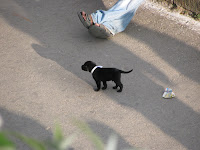
While it may sound like there’s a lot of monkey-chasing going on, there really isn’t. Dogs and monkeys can be wary of each other, but often they will leave each other alone.
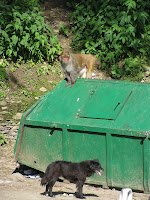
In Shimla, the dogs appear hardier, many with thick coats, probably due to the fact that it gets cold up here in the Himalayan foothills. They are generally cared for better, insofar as many of them have been spayed or neutered (which is easily revealed by the notch cut into their ears). Plus people seem to adopt local strays by giving them leftovers.

Since Shimla is rather small, it’s easy to get to know the neighborhood strays. There are four that live up at Jakhu temple, who keep the monkeys in check and also spend a lot of time sleeping. There’s one who lives by the corner shop near our hotel that Danny often says hello to.


Subscribe to:
Posts (Atom)